
Coproheme – a naturally occuring co-factor?
SUPERVISOR: Stefan HOFBAUER
Background.
In 2000, Romão and colleagues reported that bacterioferritin from the sulfate-reducing bacterium Desulfovibrio desulfuricans contains iron-coproporphyrin III (coproheme) as a natural cofactor (Romao et al., 2000). At the time, this was a surprising discovery because no known heme biosynthetic pathway involved coproheme in a way that could explain its presence in bacterioferritin. Although the study has been cited relatively modestly, later advances in heme biosynthesis have significantly increased its relevance.
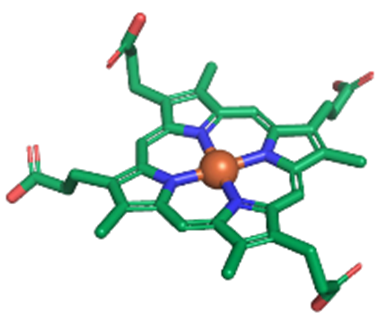
Coproheme is now known to be a key intermediate in two of the three currently recognized heme biosynthesis pathways: the siroheme-dependent (SHD) pathway, used by Archaea and sulfate-reducing bacteria, and the coproporphyrin-dependent (CPD) pathway, used by Gram-positive bacteria. In both pathways, coproheme is converted into heme b by decarboxylation, although through fundamentally different enzymatic mechanisms (Layer, 2020). These discoveries provide a new context for understanding the earlier observation of coproheme storage in bacterioferritin. Additional support comes from a 2025 preprint reporting coproheme storage in mini-bacterioferritins from anaerobic methane-oxidizing archaea (Wissink et al., 2025).
Recent research also suggests that coproheme is not merely a biosynthetic intermediate. It can undergo oxidation and reduction reactions, form high-valent reactive intermediates, and support catalytic activity. For example, variants of coproheme decarboxylase exhibit catalase activity, and preliminary studies indicate that other heme enzymes, such as chlorite dismutases, may function with coproheme instead of heme b. These findings raise the possibility that nature has evolved enzymes that preferentially utilize coproheme as a redox cofactor.
Aims and Methods.
The proposed project aims to investigate this possibility by addressing three key questions: (i) whether coproheme can support efficient enzymatic catalysis, (ii) whether enzymes exist that preferentially use coproheme over other cofactors, and (iii) whether coproheme could become a valuable platform for future enzyme engineering. Because coproheme differs structurally from heme b, being larger and containing additional propionate groups, it may confer distinct biochemical properties and protein interactions.
The project will proceed in three stages: first, characterizing known heme enzymes reconstituted with coproheme; second, studying enzymes from organisms that synthesize heme through the SHD or CPD pathways; and third, identifying potential coproheme-dependent proteins through literature, genomic, and structural analyses. This work could reveal an overlooked class of natural cofactors and expand our understanding of heme-dependent biology.
REFERENCES
Layer, G. (2020). Heme biosynthesis in prokaryotes. Biochim Biophys Acta Mol Cell Res 1868, 118861.
Romao, C.V., Louro, R., Timkovich, R., Lubben, M., Liu, M.Y., Legall, J., Xavier, A.V., and Teixeira, M. (2000). Iron-coproporphyrin III is a natural cofactor in bacterioferritin from the anaerobic bacterium Desulfovibrio desulfuricans. FEBS Lett 480, 213-216.
Wissink, M., Engilberge, S., Leão, P., Jansen, R.S., Jetten, M.S.M., Royant, A., Welte, C.U., and Wagner, T. (2025). Mini-bacterioferritins: Structural insight into a new type of ferritin-like protein from an anaerobic methane-oxidising archaeon. bioRxiv, 2025.2006.2006.658376.
Layer, G. (2020). Heme biosynthesis in prokaryotes. Biochim Biophys Acta Mol Cell Res 1868, 118861.