
Use of Advanced Free-Energy Methods for Protein Systems
SUPERVISOR: Chris OOSTENBRINK
Background.
Free energy perturbation (FEP) methods are widely used in drug discovery to calculate free-energy differences between different chemical compounds in solution and in protein systems. Then, relative binding free energies can be obtained using thermodynamic cycles. However, a recurring challenge in FEP methods are high free-energy barriers between states in the configurational space, which may be crossed infrequently or never.
Among FEP methods, enveloping distribution sampling (EDS) is a single step alchemical perturbation that uses a single reference state Hamiltonian consisting of the Boltzmann weights of the different end-state Hamiltonians with their specific energy offsets. While the original EDS version smoothened the energy landscape to improve configurational sampling, the later developed accelerated EDS (AEDS) boosts defined regions of the reference-state potential energy landscape depending on Emax and Emin parameters, which are determined through a parameter search run [1]. While the AEDS method has been successfully used on protein-ligand systems [2,3,4], its use in amino-acid perturbations remains unresolved.
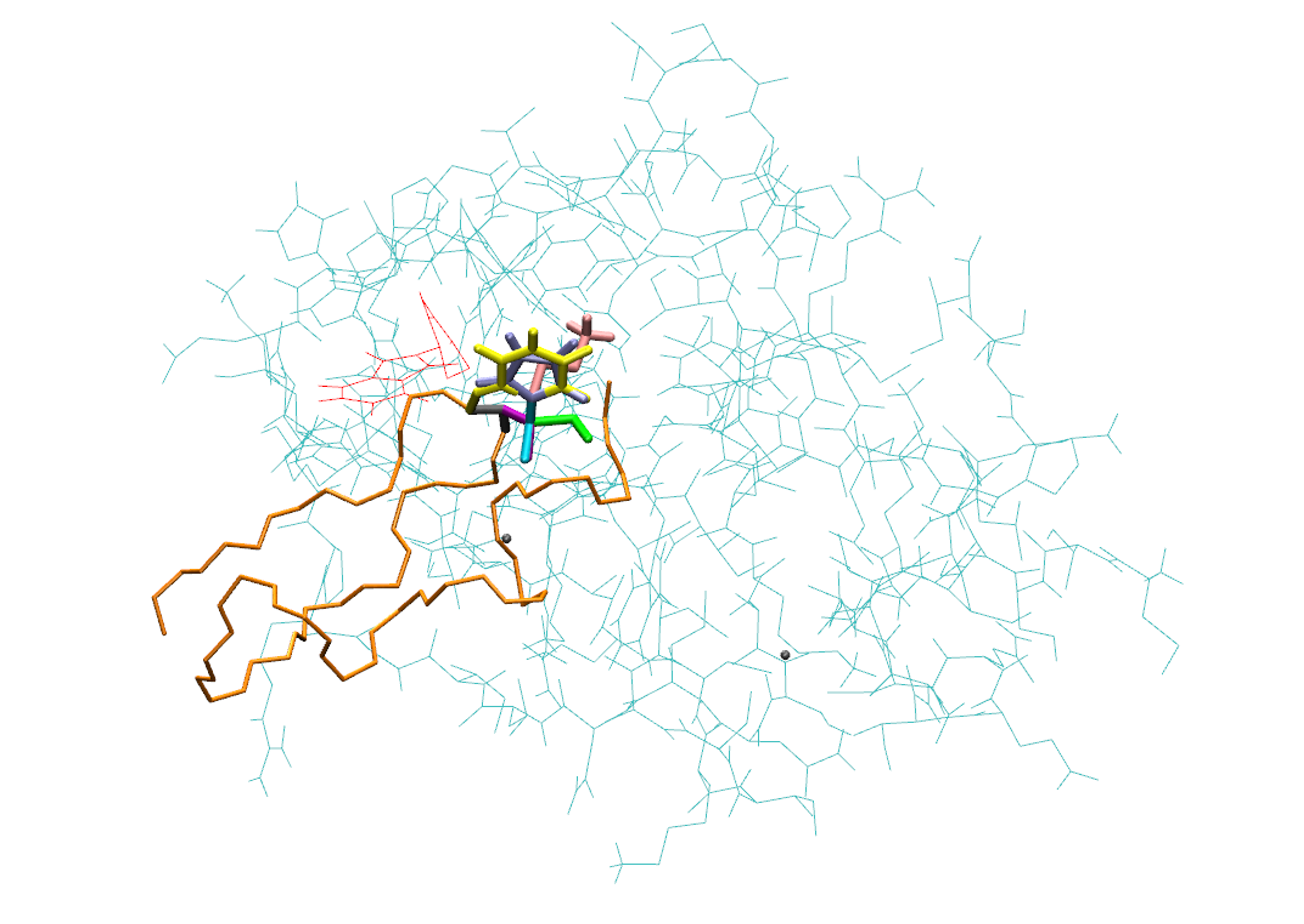
Aims and Methods.
The doctoral project aims to investigate the use of A-EDS on protein systems to calculate free energy differences in point mutations and the use of A-EDS to discriminate docking poses. The approach is being tested on the SALL4-Thalidomide-CRBN ternary complex, where amino-acid alchemical perturbations are performed on the SALL4 zinc finger to determine which sequence changes make a better CRBN-Thalidomide target. The work also includes reviewing the current method and its implementation to other md engines to seek improvements.
REFERENCES
1. Perthold, J. W., & Oostenbrink, C. (2018). Accelerated enveloping distribution sampling: Enabling sampling of multiple end states while preserving local energy minima. The Journal of Physical Chemistry B, 122(19), 5030–5037. https://doi.org/10.1021/acs.jpcb.8b02725
2. Gracia Carmona, O., & Oostenbrink, C. (2022). Accelerated enveloping distribution sampling (AEDS) allows for efficient sampling of orthogonal degrees of freedom. Journal of Chemical Information and Modeling, 63(1), 197–207. https://doi.org/10.1021/acs.jcim.2c01272
3. Grundschober, N., Dujmovic, V., Oostenbrink, C., Petrov, D., Jandova, Z., Bergner, A., & Galicia-Andrés, E. (2026). Unveiling the KRAS relationship between affinity and dynamics: A molecular simulations study. Journal of Chemical Information and Modeling, 66(14), 8522–8532. https://doi.org/10.1021/acs.jcim.6c01239
4. Perthold, J. W., Petrov, D., & Oostenbrink, C. (2020). Toward automated free energy calculation with accelerated enveloping distribution sampling (A-EDS). Journal of Chemical Information and Modeling, 60(11), 5395–5406. https://doi.org/10.1021/acs.jcim.0c00456