
Structural and Functional Analysis of the Interactome of Myeloperoxidase
SUPERVISOR: Vera PFANZAGL
Background.
Myeloperoxidase (MPO) is a key enzyme of the innate immune system and an essential component of the neutrophil antimicrobial machinery that combats invading pathogens [1]. Conversely, dysregulated MPO activity has been implicated in a wide range of chronic inflammatory diseases, posing a substantial medical burden, particularly in ageing populations [2].
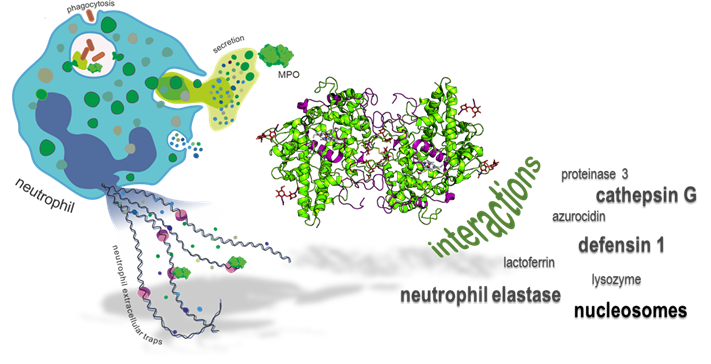
Classically, MPO’s role in the neutrophil-mediated immune response is well defined. Following complex biosynthesis, MPO is packaged into azurophilic (primary) granules and, upon degranulation, released into the phagosome alongside other granular proteins. Alternatively, MPO is essential for the formation of neutrophil extracellular traps (NETs), webs of decondensed DNA and proteins that are externalised by neutrophils [3]. Increasing evidence highlights the importance of direct interactions between MPO and other predominantly granular proteins, including neutrophil elastase and cathepsin G, as well as nucleosomes; these interactions are governed by MPO’s structural and functional properties [4, 5].
Aims & Methods.
This PhD project aims to elucidate the molecular interactions involving MPO during critical antibacterial processes, including phagocytosis, degranulation, and the formation of neutrophil extracellular traps (NETs). Using an interdisciplinary approach that integrates structural biology, enzymology, and molecular biology, the project seeks to map the MPO interactome and provide new insights into how specific structural and biochemical features regulate MPO reactivity within complex biological environments. This work will generate structural and biochemical data to characterise MPO–protein complexes and to investigate how MPO biosynthesis and post-translational modifications influence its interactions with other proteins.
The main objectives are to (i) identify protein complexes formed between MPO and other neutrophil proteins, (ii) investigate how post-translational modifications influence these protein–protein interactions at both enzymatic and cellular levels, and (iii) perform structural and biochemical characterisation of MPO–protein complexes.
We will specifically identify MPO-interacting proteins from neutrophil subcellular compartments at different stages of neutrophil activation. We will then express or purify the interaction partners and use advanced biophysical methods (e.g., surface plasmon resonance, isothermal titration calorimetry, multi-angle light scattering, X-ray crystallography, cryo-EM, and others) to rationalise and define the driving forces and biological relevance of these interactions. In addition, we will use CRISPR-based genome editing of neutrophil-like cell lines to investigate protein–protein interactions in a cellular context and to assess the effects of targeted mutations on MPO biosynthesis, intracellular trafficking, distribution, and activity.
REFERENCES
[1] Kettle A.J. et al., Myeloperoxidase: a key regulator of neutrophil oxidant production. Redox Rep 3:1 (1997), DOI: 10.1080/13510002.1997.11747085
[2] Klebanoff S.J., Myeloperoxidase: friend and foe. J Leukoc Biol 77:5 (2005), DOI: 10.1189/jlb.1204697
[3] Papayannopoulos, V. Neutrophil extracellular traps in immunity and disease. Nat Rev Immunol 18, 134–147 (2018). DOI: 10.1038/nri.2017.105
[4] Metzler K.D, et al., A Myeloperoxidase-Containing Complex Regulates Neutrophil Elastase Release and Actin Dynamics during NETosis, Cell Reports 8 (3), 883-896 (2014). DOI: 10.1016/j.celrep.2014.06.044
[5] Burn, G.L., Raisch, T., Tacke, S. et al. Myeloperoxidase transforms chromatin into neutrophil extracellular traps. Nature 647, 747–756 (2025). DOI: 10.1038/s41586-025-09523-9